ひらめき☆ときめきサイエンス 2026 at Nagoya University
ひらめき☆ときめきサイエンス 2026
On August 18–19, 2026, we conducted the ひらめき☆ときめきサイエンス~ようこそ大学の研究室へ~KAKENHI program at the Graduate School of Informatics, Nagoya University, in the Mori Laboratory.
This year’s program welcomed 12 junior high school students. The participants were highly engaged throughout the activities and showed strong interest in learning about the bronchial structure and how artificial intelligence can be applied to medical image analysis.
Hands-on AI-Based Bronchus Segmentation
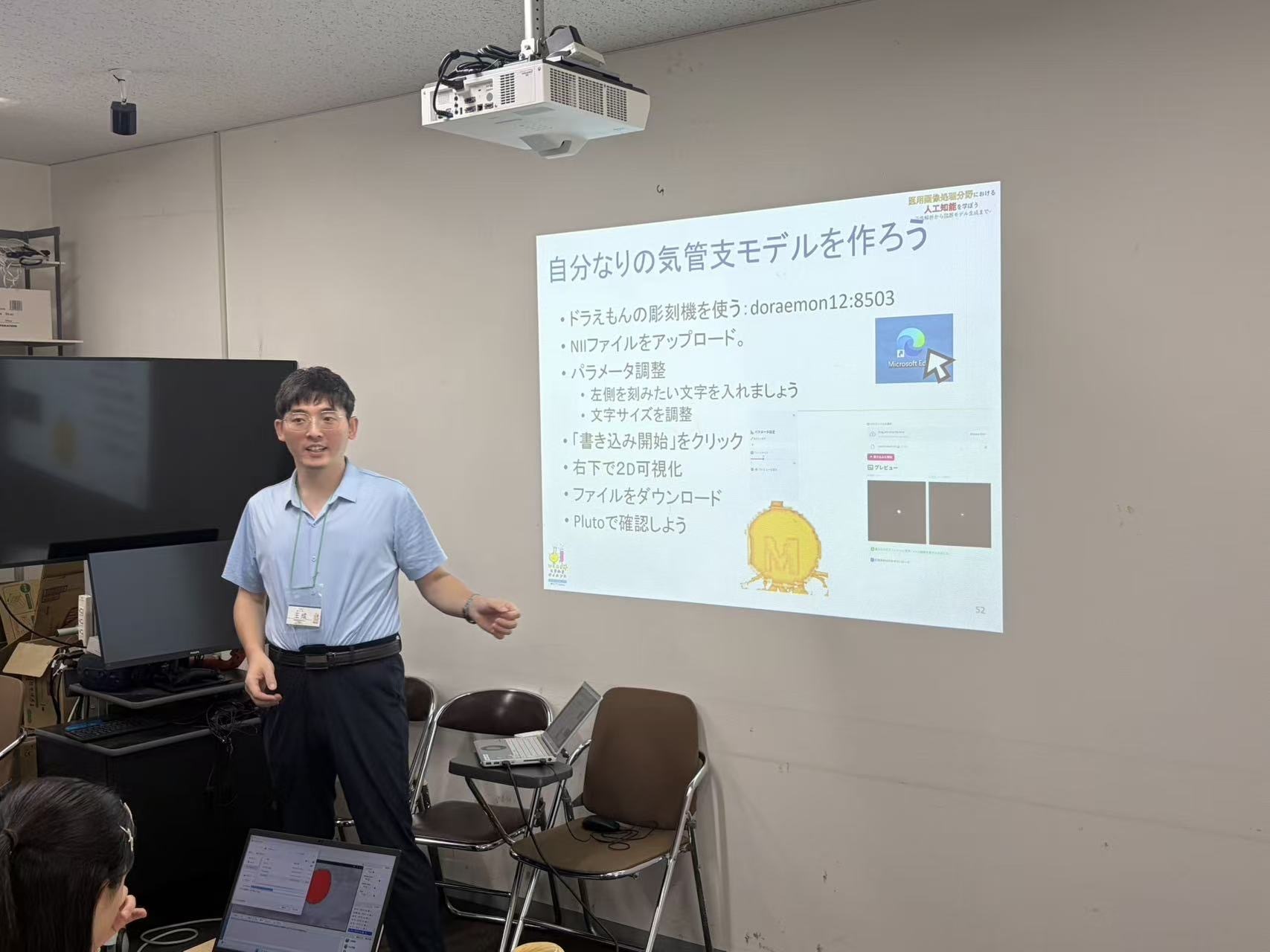
I continued to be responsible for the hands-on activity on AI-based bronchus segmentation.
The students experienced a workflow in which medical CT data were processed using artificial intelligence to automatically extract the bronchial structure and visualize the result in three dimensions.
The activity was designed to help students understand how medical images can be analyzed computationally and how AI technologies can support the visualization and interpretation of anatomical structures.
Support from Our Master’s Students
This year’s activities were also strongly supported by master’s students in our laboratory.
Their assistance with student guidance, hands-on exercises, and communication helped the program run smoothly and made it easier to provide individual support to the participants.
The cooperation among laboratory members was an important part of creating an effective and enjoyable learning environment.
Improving the Data Transfer System
One of the technical improvements this year was the further development of the data distribution and collection system used during the hands-on exercises.
In previous implementations, USB storage devices were sometimes required to transfer data between computers. This year, the improved system allowed the entire workflow to be completed without using USB devices, making data transfer faster and more convenient.
This improvement helped reduce unnecessary waiting time and allowed the students to focus more on the hands-on activities.
Responding to an Unexpected GPU Server Problem
During the program, the GPU server doraemon04, which was used for AI model training and processing, unexpectedly encountered a technical problem.
I carried out an emergency response to restore the computing environment and ensure that the hands-on activities could continue with minimal interruption.
Although unexpected technical issues can occur during practical educational activities, the experience also highlighted the importance of preparing flexible backup strategies and being able to respond quickly during live demonstrations.
Positive Feedback
The program received positive feedback, and it was particularly encouraging to see the students actively engage with the bronchial structures and AI-based image analysis.


Their interest and serious attitude made the two-day program a rewarding experience for both the participants and the organizers.
I hope that this kind of hands-on activity can continue to provide young students with opportunities to experience how artificial intelligence, medical imaging, and computer science can be connected to real research.